

AI Agents vs Chatbots: Enterprise Decision Guide (2026)
Blog
AI Agents vs Chatbots: Enterprise Decision Guide (2026)
Your company spent six figures on a chatbot last year. It answers questions well. Users like it. And yet, your operations team is still doing the same manual work.
This is the most common outcome when enterprises confuse two fundamentally different technologies: chatbots and AI agents.
The confusion is understandable. Both are AI-powered. Both live at the conversation layer. Both promise to automate work. But they solve different problem classes, require different system architectures, and deliver fundamentally different business outcomes.
Choosing between an AI agent vs chatbot isn't a technology preference. It's a decision about how deeply you want AI embedded in your workflows.
The Core Difference: Interface vs. Intelligence
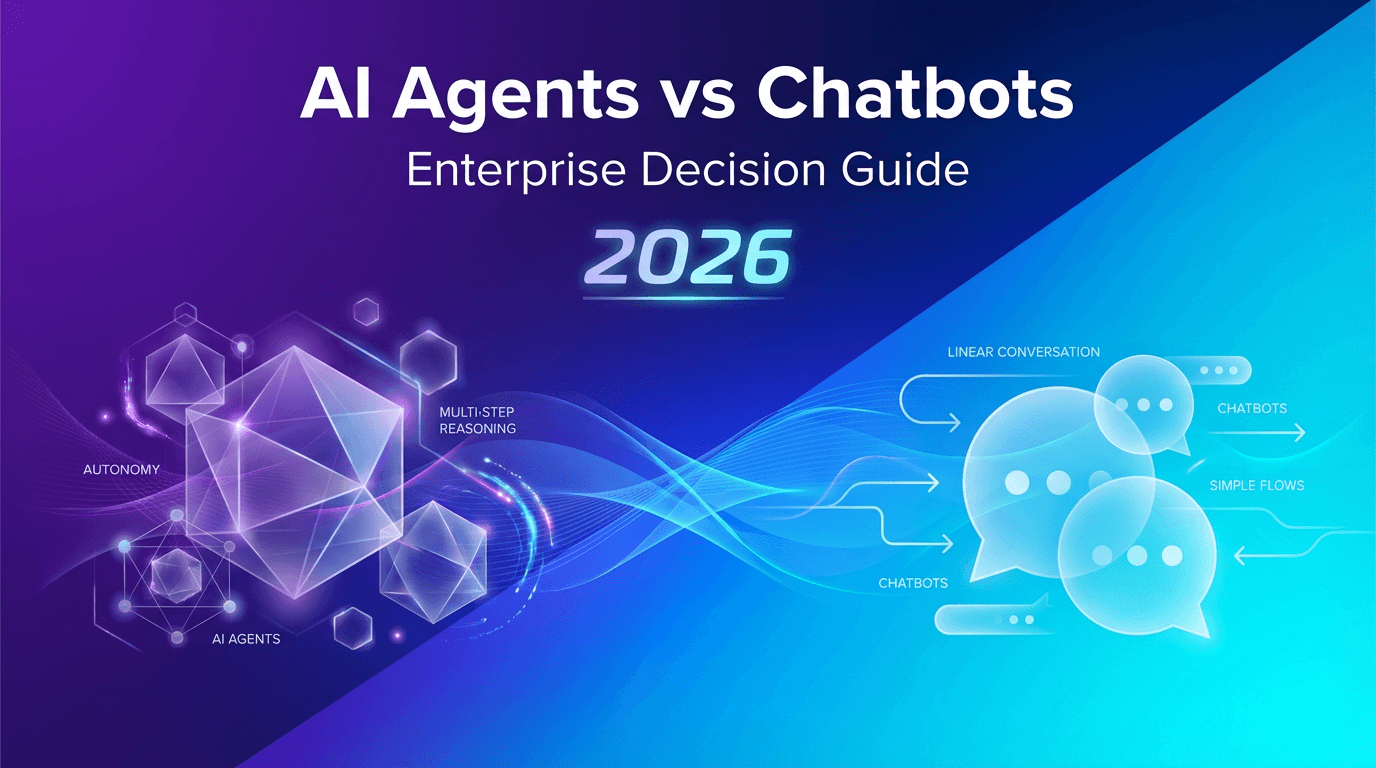
A chatbot is a conversational interface. It listens, retrieves, and responds.
An AI agent is a goal-directed worker. It plans, integrates, decides, and executes.
That distinction determines everything downstream: complexity, integration scope, operational leverage, and ROI.
What Chatbots Actually Do
Chatbots excel at three things: answering repetitive questions, routing users, and delivering information quickly.
A well-built chatbot handles FAQ density. It reduces first-contact resolution time. It prevents support queue overflow. It works by matching user intent to predefined knowledge bases, flows, or simple rules.
The value is real. Enterprises see 20-40% reduction in support ticket volume when chatbots absorb high-frequency, low-complexity questions. Users appreciate the speed. Support teams appreciate the freed capacity.
But a chatbot's impact stops there. Once the conversation becomes context-dependent, requires backend action, or demands multi-system coordination, the chatbot becomes a thin interface on top of manual work.
Most enterprises don't realize this until after launch.
What AI Agents Actually Do
An AI agent is architecturally different. It doesn't just respond; it acts.
An agent can ingest context from multiple sources, reason about a goal, break problems into steps, call APIs or tools, interpret results, and decide next actions based on outcomes. It operates with memory, handles ambiguity, and adjusts based on constraints.
In practice, this means an agent can qualify a lead across CRM, email history, and account data simultaneously. It can assemble a compliance document across multiple systems. It can route a support request to the right queue based on priority, history, and current team capacity. It can initiate a refund request, verify eligibility, update accounting, and notify the customer in a single workflow.
An agent doesn't just talk about the work. It does the work.
Why Enterprises Get This Wrong
Most companies inherit this decision from their vendor conversations, not from their actual workflows.
A chatbot vendor comes in with a slick interface and an easy pitch: "Automate your support." The chatbot gets built. It works. Everyone calls the project successful. But it absorbs only the top 15% of easy inquiries. The other 85% still requires human routing and manual processing.
An agent project takes longer, costs more, and requires deeper technical integration. So it gets deferred. The organization lives with the chatbot and assumes "that's just the limitation of AI."
The real limitation isn't AI. It's that they bought an interface when they needed a system.
When a Chatbot Is Enough
A chatbot is the right choice when your problem is information velocity, not workflow execution.
If you're solving for response time on common questions, a chatbot delivers immediate value. If your support team is drowning in repetitive asks and you want to deflect traffic, a chatbot works. If your goal is faster user onboarding through guided conversations, a chatbot is appropriate.
Chatbots also make sense as the first step. Some organizations use a chatbot to learn interaction patterns, identify automation opportunities, and collect business case data for deeper AI investment later. That's pragmatic.
But if you're measuring success by "percentage of inquiries resolved without human touch," a chatbot will disappoint. It will show initial momentum and then plateau.
When an AI Agent Becomes Mandatory
An agent becomes the right choice when work involves outcomes, not just responses.
If your process requires checking multiple data sources before making a decision, an agent is necessary. If users expect the system to actually complete something—not just explain how to complete it—an agent applies. If your workflows span multiple systems that don't natively integrate, an agent provides the bridge.
Enterprise operations commonly hit this ceiling in specific areas:
Lead qualification: A chatbot can ask screening questions. An agent can validate answers against your CRM, check account history, assess deal fit against your current pipeline, and queue qualified leads directly to the sales team.
Claims processing: A chatbot can explain the claims process. An agent can collect information, verify eligibility against policy data, retrieve relevant documentation from your system, calculate payout based on rules, and initiate payment without human review.
Employee onboarding: A chatbot can explain your HR policies. An agent can coordinate information collection, trigger systems access requests, route to different stakeholders based on role, update your HRIS, and deliver a personalized checklist.
Order exception handling: A chatbot can explain your returns policy. An agent can verify the return window against order date, check inventory impact, assess refund eligibility against your business rules, initiate the refund, update fulfillment, and notify the customer.
In each case, the business outcome is measurable: reduced processing time, lower cost per transaction, fewer escalations, higher first-contact resolution. That's the payoff of an agent.
The Decision Framework
If success means "faster answers," a chatbot gets you 80% of the way there.
If success means "fewer manual steps," "faster process completion," "reduced operational cost," or "higher accuracy," an agent is the economics play.
Then ask these questions:
How many systems is the answer in?: If your answer lives in one database or document set, a chatbot can retrieve it. If your answer lives across CRM, accounting, inventory, and compliance systems, only an agent can synthesize it.
Does context matter?: If every user gets the same flow, a chatbot works. If the response changes based on history, priority, or business rules, an agent is required.
Who measures success?: If your support team measures success, ask them whether they want faster ticket deflection or fewer manual escalations. If your finance team measures success, they care about cost per resolution. If your operations team measures success, they care about throughput. Agents drive measurable operational improvement; chatbots improve user experience.
How much human judgment can you automate?: A chatbot handles judgment-free scenarios. An agent handles scenarios where you have rules but no conversation is possible at scale.
How Internative Approaches This
We don't start with technology. We start with the constraint.
When an enterprise asks us whether they need an agent or a chatbot, we first map their workflow. Where is the work actually slow? Where is manual effort concentrating? What's the financial impact of that slowness?
Then we look at the technical landscape. What systems does the work touch? How are those systems connected today? What's automated, and what's manual.
Only after we understand the problem do we recommend the solution.
Often, the answer is "a chatbot in front of a streamlined workflow." We'll redesign the back-end process first, then add the conversational layer. That's why our healthcare clients use AI to screen insurance eligibility before a single clinical conversation happens. That's why our hospitality partners use intelligent systems to coordinate room reservations, guest preferences, and service requests across fragmented operations.
We've seen agencies build chatbots that sound great and deliver nothing. We've seen agents that are over-engineered for simple problems. The difference is always starting with the business outcome.
If you're evaluating an AI agent vs chatbot for your operations, start by asking: What's the bottleneck? How many people does it tie up? How much would it cost to fix it with hiring? If the cost of fixing it with hiring is high, the case for an agent exists. If the cost is low, maybe your problem was never that deep.
The worst decision is letting a vendor choose your technology based on what they sell best. The best decision is letting your operations choose based on what works.
A Quick Summary
A chatbot is a conversational interface optimized for deflection and speed. It's valuable when your problem is information volume. It's insufficient when your problem is operational execution.
An AI agent is a goal-directed system that coordinates work across multiple sources and systems. It's necessary when your problem touches multiple systems, requires decision logic, or demands coordinated action.
Most enterprises need both. They need a chatbot for the easy 20%. They need an agent for the important 80%. The mistake is building the chatbot and stopping there.
The opportunity is understanding which layer solves your constraint and investing there first.